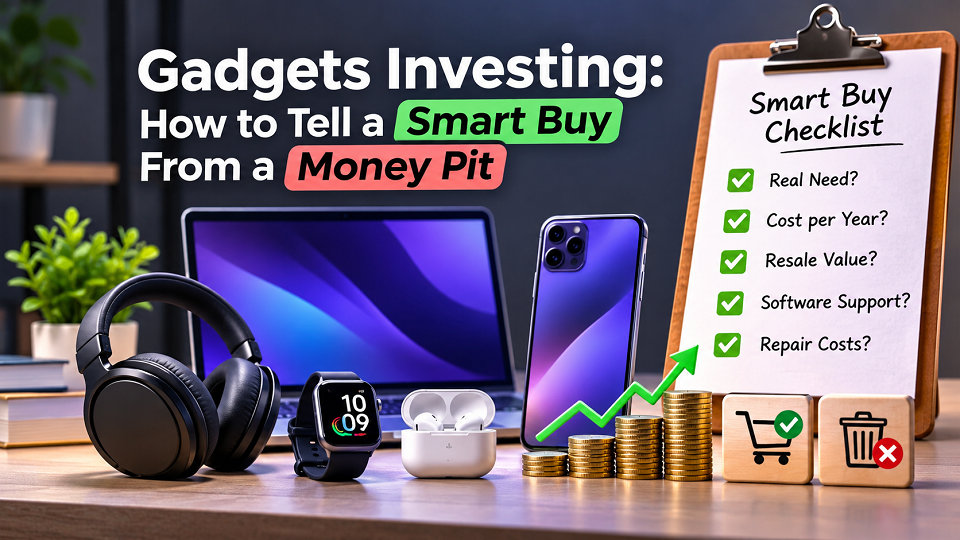
Quick answer: For most people in the US, gadgets investing isn’t really investing. A phone, laptop or smartwatch usually resells for less than you paid, so it behaves like an expense. A gadget earns its price only if it saves you money, helps you make money, or keeps enough resale value that its yearly cost stays low. Below is a quick way to check that before you buy.
Picture the checkout page. A $1,000 phone, a “limited time” discount, and a small voice asking whether this is a smart move or just an expensive one. That’s the question behind most searches for gadgets investing, and the answers online rarely agree, because the phrase means about four different things.
So here’s the plan. We’ll sort out those meanings, look at what resale data actually says (and where it contradicts itself), run a cost-per-year test you can finish in a few minutes, and point to free tools for checking real prices. Gadget stocks get a short, educational section near the end. They’re a separate topic with separate risks.
What Does Gadgets Investing Actually Mean?
Ask ten people and you’ll get a few different answers. Some mean buying a device for work or fitness and hoping it pays for itself. Others mean buying to resell or collect, which is closer to a side business than to saving. And plenty mean buying shares in companies like Apple or Sony, which has nothing to do with owning the device itself.
Mixing these up is how people end up treating a $1,200 laptop like a retirement account. It isn’t one. If it saves or earns you money, it was a good purchase. If not, it was still a purchase, and that’s fine, as long as you know which one you’re making.
Are Gadgets a Good Investment? What Resale Data Shows
Mostly no, and the numbers back that up. Take phones, the most resold gadget of all. Swappa, a US used-electronics marketplace, tracks what devices fetch as they age. In its June 2026 resale data, an iPhone about two years old kept roughly two-thirds of its original price, and one about four years old kept around a third. Google Pixels of the same ages kept less.
| Device age | iPhone | Google Pixel |
| About 1 year | 91% | 59% |
| About 2 years | 66% | 46% |
| About 3 years | 48% | 36% |
| About 4 years | 35% | 29% |
Share of original price retained, from Swappa’s June 2026 data. Base storage differs between models, so use it as a guide, not a quote.
Don’t treat any single table as gospel, though. Other trackers report steeper first-year drops. The UK-based Compare & Recycle, for example, found the iPhone 16 series lost about 45% of its value in year one, and Swappa itself admits most figures floating around online are estimates. They disagree because they measure different things: trade-in offers, sold listings, different storage sizes. What every source agrees on is the shape of the curve. The biggest drop comes early, and foldables tend to fall fastest.
There are exceptions. Rare, sealed or historically important devices can climb in price, but that’s collecting, and it leans on luck, storage space and a buyer showing up. I wouldn’t build a budget around it.
The Cost-Per-Year Test for Gadgets Investing
Before buying almost any device, calculate its total cost of ownership rather than looking at the purchase price alone. Include the initial purchase price, accessories, ongoing running costs, and any repairs you expect during its useful life. Then subtract what you realistically expect to recover when you sell it, after marketplace fees and shipping.
Use this formula:
Annual Cost = (Purchase Price + Accessory Costs + Running Costs + Repair Costs − Net Resale Value) ÷ Years Used
Net resale value means the estimated selling price minus marketplace fees, shipping, and other selling expenses.
This gives you a more realistic picture of what a gadget actually costs you each year.
A quick example, using hypothetical numbers:
| Cost Details | Phone A | Phone B |
| Purchase price | $900 | $500 |
| Accessories | $40 | $30 |
| Running costs | $20 | $15 |
| Repair costs | $80 | $50 |
| Expected resale price | $200 | $120 |
| Selling fees & shipping | $20 | $10 |
| Net resale value | $180 | $110 |
| Years kept | 4 | 3 |
| Annual cost | $215 | $161.67 |
In this example, Phone A costs $215 per year, while Phone B costs approximately $161.67 per year. Despite its higher initial price, Phone A costs more to own annually. These figures are hypothetical; your actual costs will depend on the device, usage, repairs, and resale market.
Do Gadgets Hold Their Value? What Moves the Price
Resale value isn’t random, and a few things you control make a real difference.
What protects the price
Condition comes first: an uncracked screen, a healthy battery, and the original box and charger. Popular, well-supported brands also find buyers faster than obscure ones. Software support matters more every year. Samsung and Google now both advertise seven years of updates on recent flagships, according to eCoATM’s resale guide, so check the maker’s own page for the exact model you’re eyeing.
What drags it down
A device that has stopped getting updates is harder to sell. So are carrier-locked phones, worn batteries and missing accessories. Repairability plays in too. If a gadget is expensive or awkward to fix, it tends to end up in a drawer rather than on a resale site.
One more timing detail. Swappa points out that phones lose most of their value in the first twelve months, which means a one- or two-year-old flagship can be a strong deal, because the first owner absorbed most of the loss. That’s a smarter move than buying new at launch if you’re watching cost per year.
When a Gadget Is Worth the Money
The purchases that hold up usually do one of three things. Some replace a bill you’d otherwise keep paying. Add up what the old way costs over two or three years and compare it with the gadget’s yearly cost; if the gap is big, you have your answer. Others raise your earning power. A reliable laptop, a decent microphone or a bigger monitor can help freelancers and remote workers finish faster or take on work they couldn’t before. Be honest about how much of that benefit is real, and how much is a story you tell yourself at checkout. And a few pass the cost-per-year test simply because you’ll use them hard for years.
The upgrades I’d skip
Skip anything that adds little over what you already own, accessories you’ll use twice, and devices bought mainly because a launch event made them look exciting. If a gadget doesn’t save money, earn money or clearly improve your day, budget for it as a treat. That’s allowed. For more buying advice, browse our Gadgets and Tech Guides sections.
Free Tools to Check a Gadget Before You Buy
These are the free resources worth opening while you fill in the three numbers. Prices and trade-in offers move around, so think of anything you see as a snapshot.
- Resale prices: Swappa and eBay (use the “sold items” filter) show what similar devices actually sold for, not what sellers are hoping for.
- Trade-in quotes: Apple Trade In and Gazelle.
- Refurbished vs new: Back Market makes the comparison easy.
- Price history: CamelCamelCamel and Keepa track Amazon prices, so you don’t buy right before a drop.
- Repairability: iFixit publishes repair guides and scores.
- Spend vs invest: the gov compound interest calculator shows what the same money could grow into if you invested it instead.
A Short Note on Gadget Stocks and ETFs
This part is information, not financial advice. Owning a share of a company that sells gadgets is a different animal from owning a gadget. Its value rides on the whole business: profits, debt, competition and what investors already expect. How much you like the product barely enters into it. Plenty of funds labeled “tech” are mostly software and chip companies too, so the label doesn’t guarantee consumer devices.
If you’re curious, start with Investor.gov, the SEC’s investor education site, and FINRA. Both are primary sources. And talk to a licensed professional before putting real money into any single stock or theme.
Common Gadgets Investing Mistakes
The big one is confusing a good product with a good deal. A great phone at a bad price is still a bad purchase. Running costs sneak up too: cases, chargers, subscriptions, extended warranties, repairs. People also overestimate what they’ll get back, forgetting marketplace fees and shipping. Many buy new when a refurbished or one-year-old model would cost far less per year. And some spend money they’ll need soon. Rent money and emergency savings shouldn’t go into a device because it’s on sale.
Gadgets Investing FAQs
Are gadgets a good investment?
Usually not. Newer models arrive and batteries wear down, so most everyday gadgets act like expenses unless they save or earn you money.
Do gadgets hold their value?
Some do better than others. Good condition, popular brands, original accessories and long software support all help. Age and wear push resale prices down, and published figures vary a lot by source.
What gadgets are worth investing in?
The ones that replace a recurring cost, raise your earning power or pass the cost-per-year test. A refurbished or one-year-old model often passes more easily than a brand-new one.
Is it better to buy gadgets or invest in tech stocks?
They solve different problems. A gadget is something you use; a stock is part-ownership of a company and carries market risk. Neither replaces the other.
Final Thoughts
Gadgets investing gets a lot clearer once you stop asking whether a device will go up in value and start asking what it costs you each year. Gather your costs and a realistic resale price, check real resale prices, and be honest about whether it saves or earns anything. That alone sidesteps most expensive mistakes.
Got a purchase you’re weighing right now? Tell us in the comments and we’ll help you run the numbers. For more buying guides, browse the latest on Tech Exploria.
This article is for general information only and is not financial advice.
How We Researched This
This guide draws on the public sources listed below. The cost examples are hypothetical, and the resale figures come from third-party trackers that measure value in different ways, so treat them as guides, not quotes. We haven’t tested the services mentioned. Prices and trade-in offers change, so confirm current numbers before buying. Last checked November 3, 2026.