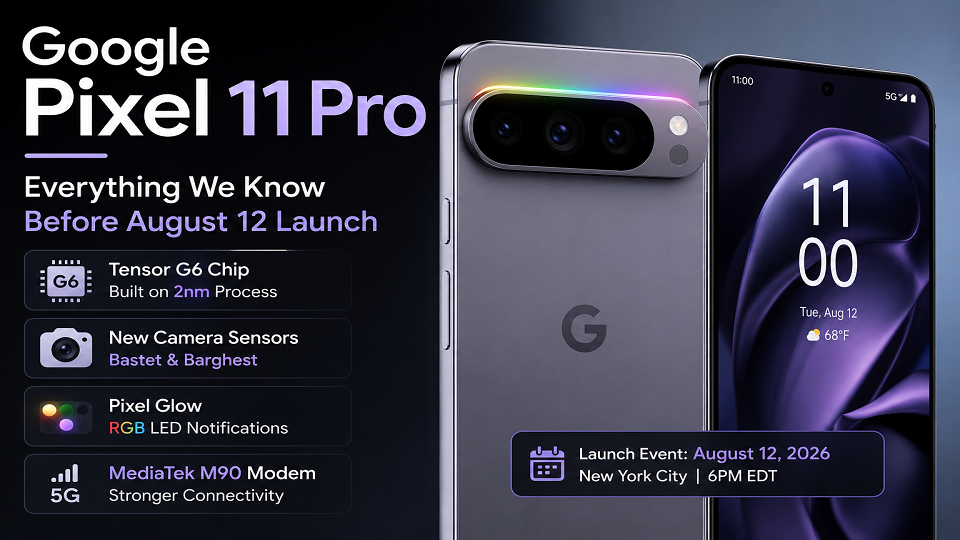
Google Pixel 11 Pro – Everything We Know Before the August 12 Launch
I’ve been tracking Pixel leaks since the Pixel 6 era, and honestly, most pre-launch details usually amount to little more than recycled speculation and renders. But this time, it’s different. What actually caught my attention this year is a specific combination: a 2nm Tensor G6 – a fabrication jump Google hasn’t attempted before – paired with a colorful new light strip on the camera bar called Pixel Glow, and, quietly, the modem swap. Google is dropping Samsung’s Exynos modem for a MediaTek M90 this generation. If you’ve followed Pixel forums at all, you know Exynos connectivity complaints have been the one recurring theme across nearly every model since the switch to in-house Tensor chips.
That last point is more significant than most people realize. Pixel users have been complaining about the modem for years – citing issues like dropped calls, rapid battery drain while searching for a signal, and fluctuating connectivity. If the shift to MediaTek proves successful, the Pixel 11 Pro might well be remembered not for its cameras, but as a reliable everyday phone.
Google has officially confirmed that the ‘Made by Google’ event will take place in New York City on August 12, 2026, starting at 6 PM EDT. Devices such as the Pixel 11 Pro and Pro XL are expected to be unveiled at the event; sales will begin on August 20, 2026, with pre-orders opening on the day of the announcement itself.
Here is everything I know; it clearly distinguishes between what has been confirmed and what has been revealed by leak sources.
Quick Answer: The Google Pixel 11 Pro is expected to launch on August 12, 2026. It will feature the Tensor G6 chip, new camera sensors, Pixel Glow RGB notifications, a MediaTek M90 modem, 12-16GB of RAM (leaked), and a starting price of around $999.
What are the release date and price of the Google Pixel 11 Pro?
For the second consecutive year, Google is bringing the event back to New York City. Pre-orders are expected to begin during the keynote, with general availability starting on August 20.
When it comes to pricing, the situation this year is truly uncertain. ‘Android Headlines’ has clearly stated that due to fluctuations in RAM and component costs, Google might not finalize the price until a week before the announcement. The Pixel 10 Pro was launched in the US at $999, and this serves as the best baseline for estimating the price.
Prices are expected to rise; information from Europe suggests it could cost around €100 (~$114) more than the Pixel 10 Pro. The base storage across the lineup might increase from 128GB to 256GB. This storage upgrade somewhat mitigates the impact of the price hike – you are paying more, but you are also getting more storage.
For US buyers, here is my honest expectation: the starting price of the Pixel 11 Pro will likely fall between $999 and $1,099, with the 512GB model potentially costing even more. Plan your budget accordingly.
Tensor G6 – Google’s First 2nm Chip
The jump to 2nm is the biggest fabrication change Tensor has seen since Google started building its own silicon. The Tensor G6 is set to utilize TSMC’s 2nm process; following the Tensor G5’s move to the 3nm process last year, this will be Google’s second Tensor chip manufactured by TSMC.
The Tensor G6 will be built using TSMC’s N2 (2nm) node process. It is expected to deliver improvements in thermal efficiency, battery life, and performance compared to previous Tensor chips. Its leaked CPU layout reportedly includes one ARM C1-Ultra core clocked at 4.11 GHz, four ARM C1-Pro cores at 3.38 GHz, and two ARM C1-Pro cores at 2.65 GHz.
What does this actually mean for day-to-day use? Pixel phones previously suffered from two annoying issues – heating up during continuous use and rapid battery drain when connected to a weak 5G network – and both of these should see significant improvement. The boost in chip performance resulting from the 2nm process is substantial.
Honestly, the modem switch matters more to me than the chip upgrade. Google is finally moving away from Samsung Exynos modems to use MediaTek’s M90 modem, which could put an end to six-year-old complaints regarding connectivity. If you have ever experienced dropped calls or noticed your Pixel’s battery draining rapidly while searching for a signal, this is the upgrade you have truly been waiting for.
I have been recommending Pixel phones to people for years, but I would always worry – deep down – about whether they might be in an area with poor signal. With the Pixel 11 Pro, perhaps even this issue will be resolved.
Google Pixel 11 Pro Camera – New sensors with currently unknown specifications
The camera leaks are the most frustrating part of this whole story – we know new sensors are coming, but not much else. Telegram leaker Mystic Leaks claims that the Pixel 11 Pro and Pro XL will feature two new sensors: one codenamed “Bastet,” likely for the main camera, and another codenamed “Barghest,” likely for the telephoto camera.
The Pixel 11 Pro and Pro XL will feature brand-new main and telephoto lenses, while all Pixel 11 models could see a major camera overhaul with a new 50MP main lens.
It is not yet clear whether these new sensors imply a higher megapixel count, a wider aperture, improved low-light performance, or a combination of all three. Given Google’s track record in computational photography, even minor hardware upgrades typically translate into tangible benefits in real-world usage.
New AI camera features are also expected. Leaks suggest these will include a “speak-to-tweak” feature – allowing you to edit photos by talking to your phone instead of navigating through menus – and a “sketch-to-image” feature that can transform rough drawings into full images. Both features seem genuinely useful rather than just gimmicky – especially “speak-to-tweak” for anyone who has ever spent twenty minutes trying to locate a specific setting.
Pixel Glow – the feature everyone is talking about
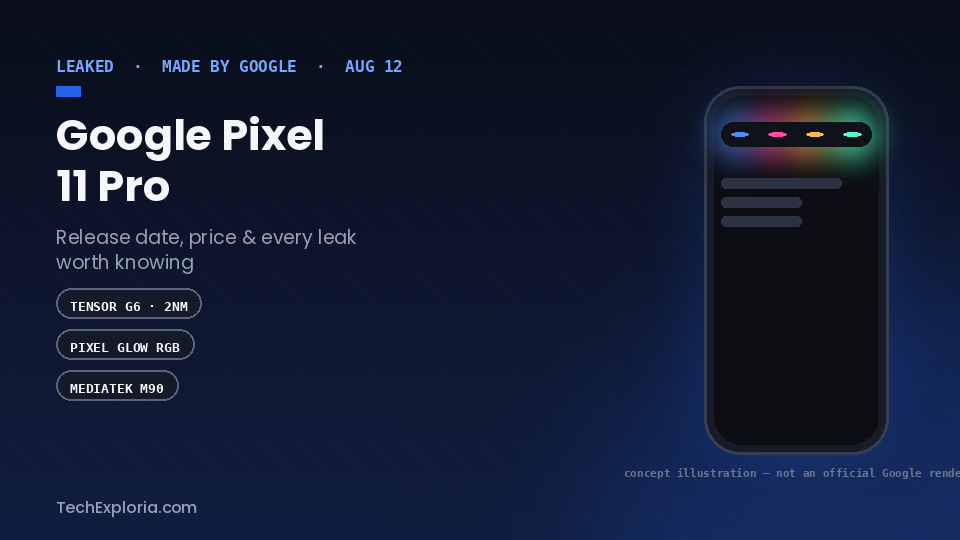
Pixel Glow is a programmable RGB LED array located on the camera bar – think of it like the Nothing Phone’s Glyph Interface, but in full color. Google is reportedly replacing the temperature sensor with Pixel Glow. Features include color-coded notifications for specific apps and contacts, a pulsing AI status indicator when processing Gemini requests, charging animations, and visual alerts for timers and alarms.
Android Authority has discovered the internal codename “Orbit” and a specific “Glow Settings” menu in the Android 17 Beta 4 – suggesting this is genuine hardware and that software has already been prepared for it.
My honest opinion: I was skeptical when details about this feature first leaked. Notification lights felt like a relic of the early Android days to me. But the way it’s been implemented here feels quite different and genuinely useful – it supports eight different colors, includes a Gemini activity indicator, and stays active even without you having to pick up the phone. If it works as described, it’s the kind of feature you don’t realize you need until you actually have it.
The Pixel 11 Pro and Pro XL are reportedly getting Pixel Glow, while it remains unclear whether the standard Pixel 11 will include it.
Google Pixel 11 Pro XL – The larger option
The Pixel 11 Pro XL is rumored to feature a 6.8-inch OLED display with a 1-120Hz refresh rate and peak brightness of 2,450 nits. It is equipped with the same Tensor G6 chip and MediaTek modem found in the standard Pro model.
The Pixel 11 Pro and Pro XL are expected to feature the same color options: Light Fog (white), Midnight Haze (black), Dune (pink), and Pine (green). This shift towards lighter, sophisticated colors marks a significant departure from the bolder colors seen on earlier Pixel models.
The Pixel 11 Pro and Pro XL are reportedly keeping the same display sizes as their predecessors but getting the M16 display material, an upgrade that should improve durability.
For US buyers choosing between Pro and Pro XL: the size difference is the main consideration. Both models appear to be getting the same camera systems and feature set this year, so it genuinely comes down to whether you want a 6.3-inch or 6.8-inch phone.
Google Pixel 11 Pro Fold – The Foldable for October
The Google Pixel 11 Pro Fold is expected in October 2026, trailing the Pixel 11 lineup by about six weeks. It’s rumored to run the Tensor G6 with a new MediaTek M90 modem, with three new cameras reportedly including a 50MP main, 48MP ultrawide, and 48MP periscope telephoto – which would be the first full camera overhaul on a Pixel foldable.
Pricing sits between $1,799 and $1,999, pressured by a global memory chip shortage. The phone ships with Android 17 and Gemini Intelligence, including App Bubbles to shrink apps to floating icons and Gboard Rambler for voice-to-text cleanup.
The timing is a genuine concern for the Pro Fold. Samsung’s Galaxy Z Fold 8 launches July 22 – three months earlier. Apple’s first foldable iPhone follows in September. By October, both rivals will already own the conversation.
If you are specifically interested in the Pro Fold, my recommendation is to wait for hands-on reviews rather than pre-ordering. The camera upgrade sounds compelling, but arriving third in a crowded foldable market means Google will need to deliver something genuinely differentiated.
Should You Buy the Google Pixel 11 Pro?
So, who should actually upgrade?
Buy the Pixel 11 Pro if:
You are currently on a Pixel 9 Pro or older and want a meaningful hardware leap. The combination of 2nm chip, new modem, new cameras, and Pixel Glow represents a genuine generational upgrade. For anyone suffering from Pixel’s historical connectivity issues, the MediaTek M90 alone might justify the purchase.
Wait if:
You already own a Pixel 10 Pro. The display sizes are the same, the design is evolutionary rather than revolutionary, and the RAM situation – potentially dropping from 16GB to 12GB on the Pro – is worth watching. That RAM reduction could matter for Gemini Intelligence performance over time.
Consider alternatives if:
You are in the US and primarily value raw benchmark performance. The Snapdragon 8 Elite Gen 5 in competing Android flagships still outpaces Tensor in pure compute tasks. Google’s advantage is software integration and camera AI – if those matter most to you, Pixel remains the right choice.
For more on AI-powered features coming to Android phones in 2026, check out our guide to best AI tools and how they’re changing everyday tech.
Pixel 11 Pro vs Pixel 10 Pro – What Actually Changes
| Feature | Pixel 10 Pro | Pixel 11 Pro |
| Chip | Tensor G5 (3nm) | Tensor G6 (2nm) |
| Modem | Samsung Exynos | MediaTek M90 |
| RAM | 16GB | 12-16GB (leaked) |
| Display | 6.3″ OLED, 2,000 nits | 6.3″ OLED, 2,450 nits |
| Camera | Previous sensors | New Bastet + Barghest |
| Notification | Temperature sensor | Pixel Glow RGB LED |
| Storage base | 128GB | 256GB |
| Price (US) | $999 | ~$999-1,099 |
| Android | Android 16 | Android 17 |
| Gemini | Gemini | Gemini Intelligence |
“All Pixel 11 Pro figures are leaked/rumored specs unless otherwise noted; this table will be updated after Google’s August 12 announcement.”
FAQ
What will the Pixel 11 Pro cost in the US?
Google hasn’t confirmed pricing. Based on the Pixel 10 Pro’s $999 launch price and leaked European increases, a $999-$1,099 range is a reasonable estimate, with higher storage tiers priced above that.
What is Pixel Glow?
A rumored RGB LED array built into the camera bar, replacing the temperature sensor found on recent Pixels. It’s reported to support color-coded notifications by contact or app, and stay active without requiring you to pick up the phone.
Will the Google Pixel 11 Pro support Gemini Intelligence?
Gemini Intelligence requires at least 12GB of RAM and Gemini Nano v3 to run on-device. The Pixel 11 Pro is expected to meet these requirements, making it one of the first phones to run Google’s most advanced AI agent natively.
What is the difference between Google Pixel 11 Pro and Pro XL?
The primary difference is display size - 6.3 inches on the Pro versus 6.8 inches on the Pro XL. Both models are expected to share identical camera systems, chip, modem, colors, and features including Pixel Glow. Choose based on the screen size you prefer.
Final Word
The Google Pixel 11 Pro is shaping up to be the most compelling Pixel in several years – not because any single spec is revolutionary, but because the combination of a genuinely improved chip, a modem that might finally fix Pixel’s connectivity reputation, new cameras, and a distinctive new feature in Pixel Glow all land together in the same generation.
August 12 is the date that matters. Set a reminder, watch the Made by Google event, and – if the hands-on reviews confirm what the leaks are promising – this might be the year a Pixel is the obvious choice rather than the thoughtful one.
We will update this article with confirmed specs and pricing as soon as Google makes the official announcement. For more tech guides and honest technology coverage, visit TechExploria.com and drop your questions in the comments below. As with any pre-launch leak roundup, some specifications may change before Google’s official announcement.
Sources
- Google’s official Made by Google event invite (August 12 date, time, location) — Android Headlines;
- Android Headlines’ Pixel 11 Pro pricing report (RAM/component cost uncertainty, “may not finalize pricing until a week before the announcement”);
- 9to5Google’s pricing/storage leak coverage (Dealabs report, €100 increase, 256GB base storage);
- Android Authority’s Pixel Glow / Android 17 Beta 4 findings (“Orbit” codename, “Glow Settings” menu);
- GSMArena’s pricing leak roundup (cross-reference).



Post Comment