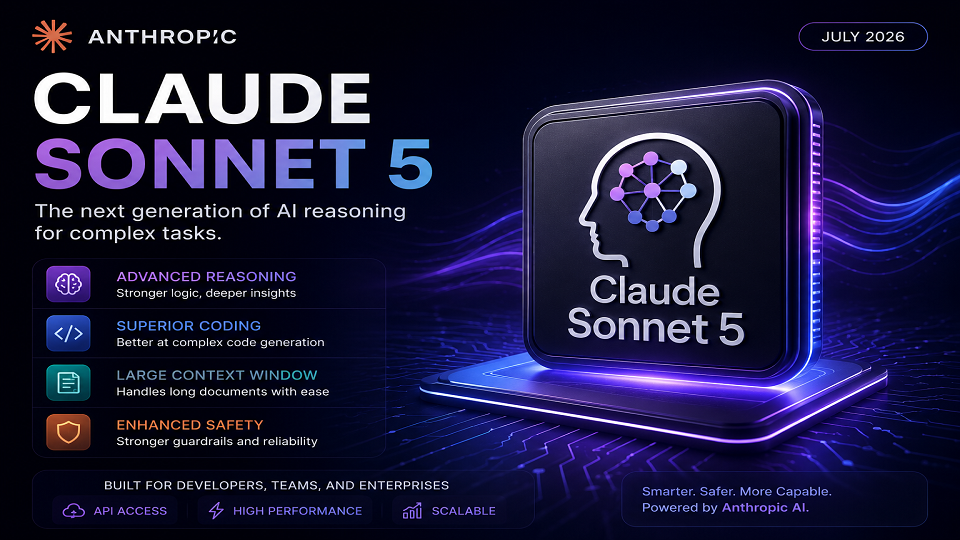
Claude Sonnet 5: The Catch Nobody Puts in the Headline
Quick summary: Claude Sonnet 5 launched June 30, 2026, as Anthropic’s default model across Free and Pro plans, priced at $2/$10 per million tokens through August 31. It’s a genuine step up on agentic and coding work – Terminal-Bench 2.1 jumped over 13 points to 80.4%. But three things the launch coverage glosses over: it runs slower on small tasks because it “overthinks,” its new tokenizer quietly inflates your token count by up to 30-35%, and Anthropic pulled Sonnet 4.6 from the picker entirely – so if you liked the old model’s speed, you don’t get to just keep using it.
Last updated: July 23, 2026. Introductory pricing referenced below ends August 31, 2026 – check Anthropic’s pricing page after that date for current rates.
Every AI lab launch follows the same script now: benchmark chart, pricing table, a customer quote about how it “just gets things done.” Sonnet 5’s launch had all three. What it didn’t have – because no vendor announcement ever does – was the part where developers who actually ran it for a week found the details that don’t show up in a slide deck.
I went looking for that part instead of repeating the spec sheet. Here’s what’s actually different about using Sonnet 5, not just reading about it.
What Changed, in One Paragraph
Sonnet 5 is the default model for Free and Pro users as of June 30, and it’s also available on Max, Team, Enterprise, Claude Code, and the API under the model ID claude-sonnet-5. Anthropic’s own announcement frames it as narrowing the gap with Opus 4.8 while costing meaningfully less – introductory pricing runs $2 per million input tokens and $10 per million output tokens through August 31, 2026, after which it resets to $3/$15. That’s the part every outlet covered. What’s more interesting is what happens once you actually start typing into it.
The Part CodeRabbit Buried: It Overthinks Small Stuff
This is the detail that actually changes how you’d use the model day to day, and it came out of CodeRabbit’s own hands-on testing rather than Anthropic’s benchmarks. Sonnet 5 defaults to adaptive thinking, and on quick one-line fixes, that shows up as a real, felt delay – CodeRabbit’s review put it plainly: where Sonnet 4.6 hands back a fast answer, Sonnet 5 keeps working for a better one, “and you feel that most on the little stuff.”
There’s a sharper wrinkle buried in the same testing: CodeRabbit measured a drop in bug-detection recall compared to 4.6, even as precision went up. In plain terms – it flags fewer total issues, but the ones it does flag are more likely to be real. Whether that’s a win depends entirely on whether you’d rather catch everything or catch fewer false alarms.
The Tokenizer Catch Nobody Puts in the Pricing Table
Anthropic mentions, almost in passing, that Sonnet 5 ships with an updated tokenizer. What that sentence doesn’t tell you is the size of the effect. Independent measurement by developer Simon Willison found the new tokenizer produces roughly 1.27 to 1.4 times more tokens for the same input, depending on whether it’s English prose or Python code. So the headline price cut – nominally cheaper per token – can get partly or fully eaten by needing more tokens to say the same thing. Anthropic’s own line is that the introductory pricing was “designed to make the transition roughly cost-neutral,” which is a polite way of saying: don’t assume your bill drops by the sticker-price ratio. Run your own before/after on a real workload before you budget around it.
You Can’t Just Stay on 4.6
Here’s the part that would frustrate me most if I were managing a team on this. Sonnet 5 didn’t launch alongside Sonnet 4.6 as an option – it replaced it. Anthropic pulled 4.6 from the model picker on claude.ai entirely, so anyone who preferred its faster, lighter-weight behavior for quick tasks doesn’t get to just keep selecting it on the consumer plans. If your workflow leaned on 4.6 specifically because it didn’t overthink small edits, that option is gone unless you’re accessing the API directly with the older model ID still available there.
Where It Actually Earns the Hype
None of the above means Sonnet 5 is a downgrade – it isn’t. On Terminal-Bench 2.1, a benchmark built around real terminal-based engineering tasks, Sonnet 5 jumped more than 13 percentage points to 80.4%, the largest single-generation gain Anthropic’s Sonnet line has posted. For long, multi-file, walk-away-and-let-it-run work, reviewers across the board – CodeRabbit included – call it a clear step up, not an incremental one. The pattern that emerges from actual usage is consistent: Sonnet 5 is built for depth over speed. Hand it something that needs 20 minutes of sustained reasoning and it earns its keep. Hand it a one-line typo fix and you’ll notice the wait.
FAQ: Claude Sonnet 5
Will Sonnet 5 actually cost less than Sonnet 4.6?
Not automatically. The new tokenizer can produce 27-40% more tokens for equivalent input, which can offset some or all of the lower per-token price depending on your content type. Test on your actual workload before assuming savings.
Can I still use Claude Sonnet 4.6?
Not through the consumer model picker on claude.ai – it’s been removed. It remains accessible via the API under its original model ID if your workflow needs it specifically.
What’s the real difference between Sonnet 5 and Opus 4.8?
Anthropic positions Opus 4.8 as still the choice for the highest-accuracy, highest-stakes work, with Sonnet 5 as the better cost-performance option for everyday agentic tasks – most reviewers agree the gap has narrowed but not closed.
Where This Leaves You
If your work is mostly sustained, multi-step tasks – refactors, research, long agent runs – Sonnet 5 is a genuine upgrade and worth switching to now while introductory pricing holds. If you mostly do quick, low-risk edits and valued 4.6’s speed specifically, budget for some friction, and consider the API route if you need the older model back.
I’ll keep testing this against real workloads and update this piece as more comes in – drop a comment if there’s a specific task you want benchmarked. For the rest of what shipped alongside Sonnet 5 this year, our AI News hub has the broader roundup.